
Laufey | Rod Laver Arena | 1st August
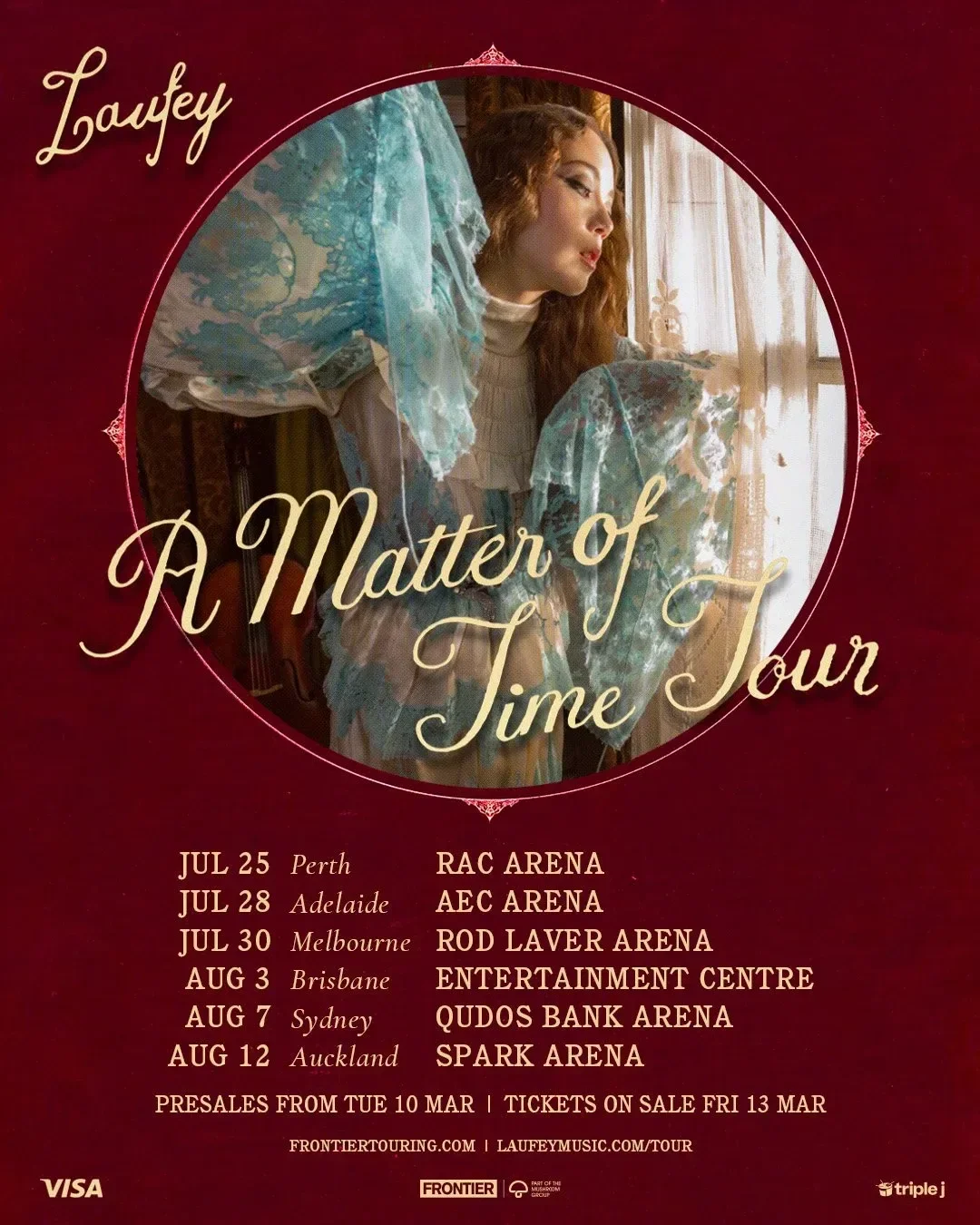
Icelandic singer and multi-instrumentalist Laufey took to the Rod Laver Arena stage last night to close out a run of three back-to-back sold out shows in Melbourne, bringing her signature blend of jazz, classical and contemporary performance to the largest audience she’s had in Australia yet.
I don’t think I’ve seen another artist make an arena size concert feel so intimate, whilst simultaneously feeling so incredibly grand and larger-than-life. The show was split up into 5 “acts” mimicking the format and delivery of old black and white films (even featuring an opening credits roll, acknowledging the names of all on-stage performers) each with a significantly different vibe. Act I was presented on an incredible dream-like bifurcated staircase that looked like something out of an old Disney princess movie. The set, created by architect Ric Lipton and Stufish designer Zarya Vrabcheva, was designed to be a “physicalization of emotion” and I think that describes it perfectly (and also beautifully). Looking at it, and seeing how Laufey and her crew of endlessly talented backing dancers interacted with it gave me a sense of childlike whimsey, like I was witnessing a dream take place right in front of my eyes.
This first act featured Laufey performing alongside her usual backing band, as well as a string quartet and the previously mentioned backing dancers, which all created a spectacle that was impossible to watch without a joyous smile. Something I noticed, however, was that a few songs throughout the set (particularly in Act I and IV) featured songs that used playback tracks to add extra layers of vocal harmonies, which I actually found a bit distracting and did break my immersion slightly. Having the entire arena filled with sound being performed live from the incredibly talented musicians on stage felt like magic, but having the harmonies and vocal layers be on playback just felt a bit unnatural to me. This is a small gripe however, and really only complaint about the show at all.
Act II was named “Jazz Club” and saw Laufey and her main backing band (consisting of Heather Rivas on keys, Dario Bizio on bass and Maverick MacMillan on drums) at the front of the stage’s walkway to perform new jazz renditions of 4 of her older songs (as well as the standard ‘Old Devil Moon’) fit for an underground bar during prohibition. It was classy, dynamic and it sounded incredible (huge shoutout to whoever was on FOH audio that night), a very welcome change of pace to the night that allowed Laufey to flaunt her jazz chops without coming across as self-indulgent or out of place.
Seeing how loyal (and intense) Laufey’s fanbase was had me thinking; how does an artist whose work is so ingrained with the aesthetics of a sound that was popular more than 60 years ago have such a mainstream appeal? Or, to be more specific and/or cynical, how does the music industry in 2026 allow for a classical and jazz artist to become part of the cultural zeitgeist and garner a fanbase so young and dedicated? So I did a bit of digging. Laufey is signed to a music distribution company named AWAL (or Artists Without a Label) which allows its artists to retain full creative control over their work whilst providing them with the promotional resources usually reserved for the big record labels. I think Laufey’s choice to work with AWAL was absolutely the the most best decision regarding her career she could have made- she knows that there is audience for this music, which is honestly timeless at its core, and she’s proven that weaving in modern songwriting sensibilities with classical, old-timey aesthetics is a recipe that is simply irresistible. Anyone can listen to Laufey’s music, or watch a performance, and be not only Impressed but thoroughly entertained, as I was for the entire duration of her performance.
I’m so thrilled I had the honour of seeing Laufey perform last night. I’ve used this word a few times, but it genuinely felt magical being there with so many people equally as enamoured with the performance taking place. If Laufey doesn’t end up as a generational artist, up there with the jazz and classical all-timers, then the timeline probably got messed up somewhere. I believe it’s inevitable.